Digital SafeGuard (Universal Installation)
1.) MOUNTING LOCATION: The passenger compartment is the preferred location for mounting the black box since the unit is not sealed from moisture and the components are not specified to operate above 170 degrees F. When locating a mounting spot, keep in mind the length of the power harness and the sensor cable. Since the box has a sensitivity adjustment that must be made during a test drive, do not mount the unit at this time.
2.) WIRING HARNESS AND SENSOR CABLE: Perhaps the most difficult part of the installation is finding a suitable place for the wires to go through the firewall. Newer cars have sealed grommets, but these can be carefully sliced into with a knife in an "X" pattern. Otherwise, drill a 1/2" hole in the firewall and install the grommet supplied with the kit.
3.) ELECTRICAL CONNECTIONS: Keep in mind that the unit simply connects in series between the points (or electronic ignition) and the coil negative, and you shouldn't have any trouble. See figure 1 below.
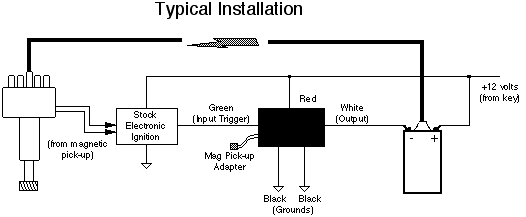
a.) Locate the wire at the coil negative. On GM with HEI, this will be the brown wire in the three wire connector. On Ford with Dura Spark, this should be the green wire with yellow dots. On many foreign cars you will find that there is more than one wire at the coil negative. In this case you must determine which one comes from the ignition module. The other wires probably go to the tach, the diagnostic connector, or the fuel injection computer. It may be easier to go directly to the igniter module to find the source of the coil negative wire.
b.) After locating the coil negative wire, cut it at a convenient point, strip both of the cut ends and crimp a female "bullet" connector to the end going to the coil. On GM HEI this would be the wire still in the connector going to the cap. Crimp a male to the other wire.
c.) Strip the WHITE wire and crimp on a male bullet connector. Plug this into the female on the coil negative wire. This is the box's output that fires the coil.
d.) Strip the GREEN wire and crimp on a female bullet connector. Plug this into the male on the ignition wire. This is the input trigger to the box.
e.) The two BLACK wires are both grounds. Strip back the insulation, twist them together, crimp on a ring terminal, and ground them to a solid point on the chassis. Make sure that if you use a sheet metal screw that it is not going to strip out on you. Remember, the ground wires are as important as the power wires.
f.) The SafeGuard RED wire supplies power to the system. It must be connected to 12 volts during cranking as well as with the key in the run position. On GM with HEI, this would be the pink wire at the three wire connector on the distributor cap or the "BATT" terminal on the cap itself. On Ford Dura Spark this would be the red wire at the Ford module. Use the wire splice provided.
Many vehicles disconnect the accessories during cranking. Connecting to an accessory wire is the single biggest reason for installation problems.
Another place that can be a problem is connecting to the coil positive. Many systems use a ballast resistor or resistance wire to the coil positive. With the key on but the engine not running, this point will read a full 12 volts. With the engine running, however, this point could drop to as low as 6 volts during dwell time. An oscilloscope would be needed to see this, as a voltmeter would show only something less than twelve volts. If you are not sure if you can connect to the coil positive, connect your voltmeter to the coil positive and with the key on, momentarily ground the coil negative terminal. If the meter reading drops below 10 1/2 or 11 volts, a ballast resistor is present or there is a bad connection in the key or wiring harness. In this case you must connect to the key side of the ballast resistor if you can find it or to the ignition switch under the dash.
4.) GM HEI systems require removal of the distributor cap and rotor for inspection of the stock electronic module. If the number 466 appears on the module, a diode (provided) must be installed between ground and the white wire of the magnetic pickup. The negative end of the diode has a ring terminal installed and should go underneath the mounting nut of the module. The positive end should be bent double and installed with the connector of the white wire onto the contact of the module. No diode is required for modules without the number 466. Some after market modules may have a sticker covering the number. Without the diode, some engines will run fine until you take your foot off the gas to shift, and then they will quit.
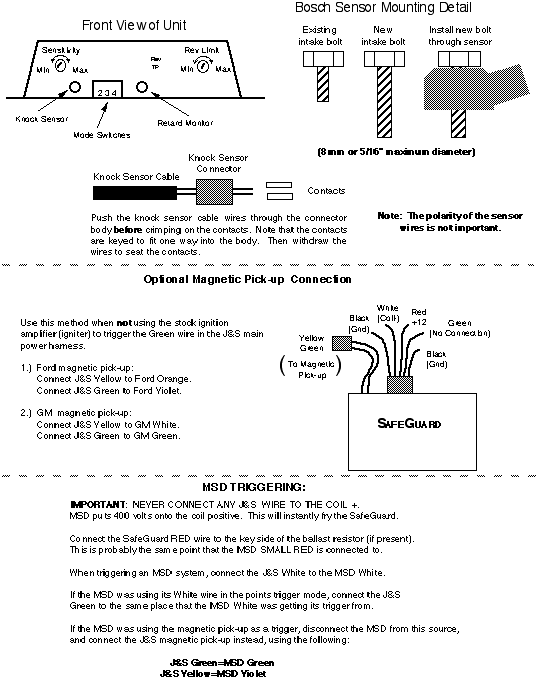
5.) SENSOR MOUNTING (Bosch sensor): The intake manifold is the easiest place to mount the sensor, but it will work better if you can mount it on the engine block. The mounting hole in the sensor is 8 mm or 5/16". Remove an existing bolt of the correct size from the manifold or other convenient location. You will then need to get a replacement bolt about a 1/2 inch longer. Install the new bolt and sensor onto the manifold, and torque to about 21 lbs. Feed the sensor cable wires through the connector before crimping the contacts onto the wires. Polarity is not important. The sensor cable is shielded, but don't run it along side the spark plug wires or near the coil if you can help it. Plug the other end of the cable into the sensor input connector on the front of the unit.
SENSOR MOUNTING (GM sensor): In general, the GM sensor will mount in place of one of the water drain plugs located in the bottom of the block. When the engine is cold, place a drip pan underneath one of the drain plugs. Remove the drain plug (have the sensor ready to screw in its place). Experience has shown that you shouldn’t lose much coolant.
Depending on your application, kits are furnished with a GM sensor with a particular thread. Most American engines have water drain plugs with a 1/4 NPT (tapered pipe) thread. Sensors can also be furnished with an M10x1.5mm straight thread or a 3/8x16 straight thread. These can be mounted in various places on the engine. For example, many Ford and GM engines have unused accessory bolt holes on the end of a cylinder head with a 3/8x16 straight thread. If you can’t find a suitable empty hole, you can always remove a bolt from the engine and have a nut with the right thread welded onto the head of the bolt. Then simply screw the bolt back into the engine, then screw the sensor into the welded-on nut.
6.) SWITCH SETTINGS: The unit must be set for 4, 5, 6,or 8 cylinder operation. This is done by setting the row of switches at the front of the unit according to the table below:
| Cyl | S1 | S2 | S3 | S4 |
| 8 | Up | ? | Up | Up |
| 6 | Up | ? | Down | Up |
| 5 | Up | ? | Up | Down |
| 4 | Up | ? | Down | Down |
Switch 2 is the All/Separate switch. Switching it up retards all cylinders by the same amount. Switching it down retards only the knocking cylinder. Blown V-8's without inter-coolers will probably require the switch set to retard all.
7.) SENSITIVITY: This screwdriver adjust control is located on the left end of the unit, nearest the sensor cable. Fully clockwise is the most sensitive setting. Setting it too sensitive may cause the unit to retard due to normal engine noises. For now, set it to mid range.
8.) REV LIMIT: This screwdriver adjust control is located at the right end of the unit. To set the rev limit, turn on the key, and with a digital voltmeter, measure the voltage between ground and the Rev Limit test point. The test point is a small solder pad on the circuit board at the front of the unit, between the monitor connector and the power harness connector. This voltage corresponds directly with the desired RPM limit. That is, 5.0 volts is 5000 RPM, etc. Resolution is in 50 RPM steps, or 0.05 volt increments. If you set the voltage at, say, 6.78 volts, the computer picks the next highest reading, or 6800 RPM. The computer reads this voltage every time the engine goes above 2500 RPM. You may alter the setting while driving, but it won't take effect unless the RPM is momentarily brought below 2500 RPM.
9.) TEST DRIVE: Take the vehicle out on the road to set the sensitivity control. If the vehicle seems to be more sluggish than usual, the unit is probably retarding too much or too often. Slowly adjust the sensitivity control until the vehicle feels normal, but does not ping under load. If you have purchased the optional Knock Retard Monitor you will be able to more accurately dial in the settings, as you will see exactly when the unit starts retarding and how far.
10.) After you are satisfied with the settings, you can permanently mount the unit under the dash or against the kick panel. Some high energy coils may make the unit run a little warm. Do not be concerned unless the metal plate is too hot to hold.
11.) BY-PASS: In the unlikely event of trouble, a by-pass plug is included. Simply disconnect the power harness from the unit and plug the by-pass plug into the harness, not the unit.
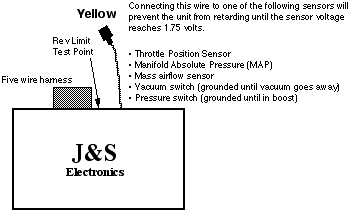
12.) Some engines may cause the unit to retad on decel. If this happens in your situation, see the drawing below to disable the retard function until your engine really needs it.